Trick of the Trade: Securing a peripheral IV on sweaty skin

Patients can become extremely diaphoretic with high fevers or if under the influence of PCP or a stimulant. Slippery, sweaty skin can pose a problem when securing peripheral IV's. Adhesive tapes that are typically designed for securing these IV's often slip off... immediately followed by the IV falling out.

How can you secure the IV ... without using staples and sutures?


Trick of the Trade:
Wrap non-cloth tape circumferentially around the arm.

  • Wrap the arm with a circumferential band of non-cloth tape which just covers the IV hub. 
  • Slide a narrow strip under the IV hub and crisscross (Chevron-shape) over the hub.
  • Secure this strip to the initial tape band layer (and not the sweaty skin).
  • Place a third tape circumferentially around the arm just distal to and covering the IV hub and tubing.
Note: Be careful about wrapping anything circumferentially around an extremity. Routinely check the extremity to avoid creating an iatrogenic tourniquet.


Thanks to Tricia and the night-shift nursing team, who are always sharing great practical pearls.

Even the best in emergency medicine can't avoid medical malpractice lawsuits ....

Peter Rosen MD reveals in Bouncebacks! Medical and Legal that he has been sued about "half a dozen" times.  Fortunately for him he never had to settle or go to court as he was eventually dismissed from all cases. 

Name 6 causes of GI bleeding in neonates (< 1 month)? What is your clinical approach to diagnosis?

  1. anorectal fissures (most common cause of rectal bleeding in patients less than 1 year)
  2. swallowed maternal blood (examine mother's nipples)
  3. coagulopathy
  4. necrotizing enterocolitis 
  5. malrotation with midgut volvulus 
  6. Hirschsprung disease 
If patient appears well and there is an obvious cause of bleeding such as a fissure or swallowed maternal blood, a minimalist workup can probably be pursued with close outpatient followup.  However, if the patient is ill and/or there is no obvious cause of bleeding consider checking labs and an abdominal x-ray to start.  


Source

Ramsook, C. and Endom, E.  "Diagnostic approach to lower gastrointestinal bleeding in children"  Up to Date. May 2011.

Happy Turkey Week!


In the holiday spirit of gluttony and giving thanks, we at Academic Life in Emergency Medicine are taking the whole week off to indulge in great food with great company.

Book Review: "Bouncebacks! Medical and Legal" by Micheael B. Weinstock and Kevin M. Klauer

Bouncebacks! Medical and Legalbrings the reader straight to the sidelines of ten medical malpractice cases providing an inside look into the courtroom as the plaintiff and defense argue their cases.  The authors spare the reader of some of the nitty gritty workings of litigation by summarizing portions of it but are sure to focus in when necessary to provide blow-by-blow accounts at critical junctures.  Intertwined with the case presentations are post-trial interviews with some of the attorneys - plaintiff and defense - and medical experts to get their inside thoughts on the case.  There is additional case commentary solicited from some of the most renowned minds in emergency medicine including Gregory Henry, Peter Rosen, Jerry Hoffman and more. 

If this book has a downside it is that one or two of the ten cases presented have already been discussed in detail on podcasts, EMRAP and Risk Management Monthly.  So if you subscribe to these, there may be some redundancy. 

Crowdsourcing all of your burning questions about EM


Have you noticed that on "Who Wants To Be A Millionaire", asking the audience as a lifeline almost always results in the right answer (over 90% of the time)?

Dr. David Thorisson (Lund University, Scandinavia) recently approached me with a novel idea of doing the same for Emergency Medicine questions. These questions are currently posted to a public Google Docs document, which allows anyone to post and answer questions.

Google Docs link:
http://bit.ly/sWx7if

Some questions already posted include:

  • Can you share your tips for distinguishing between paroxysmal SVT & atrial fibrillation (when the rate is regular)?
  • What are the contraindications to low-dose ketamine (0.1-0.5 mg/kg) for sedation or agitation? 
  • What is an accepted rate of miss for 1) ACS 2) PE 3) SA 4) Aortic dissection 5) C-spine fractures (requiring and not requiring treatment)?

Read about how David got started with this intriguing and innovative new project on his blog site Priceless Electrical Activity. Feel free to post more questions or take a stab at answering a question.

Paucis Verbis: The aVR lead on EKG

What lead is the most overlooked on the EKG? 
aVR


Lead aVR can provide some unique insight into 5 different conditions:
  1. Acute MI 
  2. Pericarditis 
  3. Tricyclic antidepressant (TCA) and TCA-like overdose 
  4. AVRT in narrow complex tachycardias 
  5. Differentiating VT from SVT with aberrancy in wide complex tachycardias by using the Vereckei criteria (possibly better than Brugada criteria)
It turns out that aVR provides a lot of great information!


You can download this PV card:  [MS Word] [PDF]
References
  • Kireyev D, Arkhipov MV, Zador ST, Paris JA, Boden WE. Clinical utility of aVR-The neglected electrocardiographic lead. Ann Noninvasive Electrocardiol. 2010 Apr;15(2):175-80. .
  • Riera AR, Ferreira C, Ferreira Filho C, Dubner S, Barbosa Barros R, Femenía F, Baranchuk A. Clinical value of lead aVR. Ann Noninvasive Electrocardiol. 2011 Jul;16(3):295-302. .
  • Vereckei A, Duray G, Szénási G, Altemose GT, Miller JM. New algorithm using only lead aVR for differential diagnosis of wide QRS complex tachycardia. Heart Rhythm. 2008 Jan;5(1):89-98. .
  • Williamson K, Mattu A, Plautz CU, Binder A, Brady WJ. Electrocardiographic applications of lead aVR. Am J Emerg Med. 2006 Nov;24(7):864-74. .

Calling all med students: SAEM Ambassador opportunity


Are you a medical student interested in EM? Want to get your registration costs waived at a national meeting? Want to come say hi to me? Here is an announcement from the SAEM website (deadline Feb 1, 2012):

_____________________


SAEM is looking for 15 energetic, self-starting, responsible, and enthusiastic medical students to work with the SAEM Program Committee at the Annual Meeting in Chicago, May 9-12, 2012. The Program Committee is responsible for the planning, coordination, and execution of SAEM’s Annual Meeting. It is comprised of nearly 40 faculty members selected by the President of SAEM from Emergency Medicine programs all over the country.

Benefits for medical student committee members:

  • Waiver of your registration fee to the SAEM Annual Meeting*
  • A member of the Program Committee will be assigned to you to serve in an advisory capacity for future EM pursuits
  • Learn much more about the current research and educational activities taking place in the field of Emergency Medicine
  • Have the opportunity to form relationships with faculty members from EM programs around the country.
  • A personal letter from the Committee Chair will be sent to your Dean of Student Affairs, acknowledging your contributions to the Program Committee.

Requirements and expectations of medical student committee members:

  • Arrive the late evening of May 8th and stay through 3pm on May 12th.*
  • Attend daily Program Committee meetings
  • Seeing to assigned tasks and responsibilities, which include, but are not limited to: Approximately 6 hours of responsibilities per day, soliciting reviews, assisting in AV needs, facilitating workshops, being responsive and flexible to the needs of the Program Committee

Interested medical students should submit their name and contact information to the SAEM office by emailing Michelle Iniguez at miniguez@saem.org. Please write “Medical Student Ambassadors” in the subject line and attach a very short statement of interest (<150 words) as well as an updated electronic copy of your CV. Deadline is February 1, 2012. Recipients will be notified by February 10, 2012.

* Travel and hotel will be the responsibility of the individual student; however. SAEM will provide the emails of other selected students to facilitate consolidating lodging expenses.


PDF of the announcement

Trick of the trade: Foley catheter for DUB

Your next patient has heavy dysfunctional uterine bleeding (DUB). She is tachycardic and pre-syncopal.

While you establish an IV, resuscitate her, and wait for the gynaecology team to arrive, is there any trick you can use to stem the bleeding?

Trick of the trade: 
Foley catheter insertion into the uterus for DUB


The obstetricians sometimes use a Bakri balloon (Bakri postpartum balloon, Cook Medical) for postpartum bleeding. This balloon will take 250-500 cc of fluid. In the ED, a regular Foley catheter can be used.

Step 1: 
Regular speculum exam. Remove clots.

Step 2: 
Feed Foley catheter through the os by curved or straight forceps held close to the os.

Step 3: 
When the catheter is in a few centimetres through the os (endometrial cavity is usually 6 - 8 cm deep), inflate the Foley balloon with 30-80 cc of water.

The balloon will hopefully tamponade the endometrium that it contacts and prevent further blood loss. 
Illustration by Simon Yiu

Thanks to Dr. Jamie Kroft for this great tip!

Reference Georgiou C. Balloon tamponade in the management of postpartum haemorrhage: a review. BJOG: An International Journal of Obstetrics & Gynaecology. 2009;116(6):748–757.

Video: Dr. Eric Mazur on peer teaching


Dr. Eric Mazur is a Harvard Professor of Physics and Applied Physics who talks about his "confessions of a converted lecturer". He focuses on the power of peer teaching and the ineffectiveness of the traditional lecture format in a classroom.

This talk is 72 minutes long. Take some time to listen and learn. Dr. Mazur is such an engaging talk that I couldn't stop watching. Maybe it's because he looks a little like the comedian Steve Carell.

“My lecturing was ineffective, despite the high evaluations.”


“The traditional approach to teaching reduces education to a transfer of information.”


"The plural of ANECDOTE is not DATA."
-- Dr. Lee Shulman (ex-President of The Carnegie Foundation)


Paucis Verbis: Methotrexate for ectopic pregnancy


Ectopic pregnancies account for as many as 18% of patients who present with first-trimester bleeding or abdominal pain in the Emergency Department. This Paucis Verbis card summarizes the 2008 American College of Obstetricians and Gynecologists (ACOG) guidelines on the use of methotrexate (MTX) for ectopic pregnancies. Not all ectopic pregnancies require operative management.

What are the indications and contraindications to MTX?

When should they follow up with their obstetrician?
Answer: In 4 days for a repeat b-HCG and possible second dose of MTX

Note that one of the eligibility criteria is that the patient must have an "unruptured ectopic pregnancy". Many would consider that any ultrasonographic evidence of free fluid may be a sign of an early rupture. It is left up to clinician judgment in how "unruptured" is interpreted.


You can download this PV card:  [MS Word] [PDF]

Reference
American College of Obstetricians and Gynecologists. ACOG Practice Bulletin No. 94: Medical management of ectopic pregnancy. Obstet Gynecol. 2008 Jun;111(6):1479-85.
.

21 y/o female presents with dysphagia and pleurisy after getting into an argument and yelling loudly at her boyfriend. What is the treatment based on her chest x-ray?

Click on image to enlarge.

Scroll down for answer


Pnuemomediastinum.  Notice the free air in the neck on the chest x-ray. 

Spontaneous, atraumatic, pneumomediastinum usually occurs when air leaks through small alveolar ruptures triggered by asthma or Valsalva maneuver and is a benign condition that resolves on its own in 2 to 15 days.  Treatment includes analgesia and avoidance of maneuvers that increase pulmonary pressure, ie. Valsalva.   Bronch is not indicated for screening of patients with isolated spontaneous pneumomediastinum.  An esophageal study (contrast esophagography or esophagoscopy) is not indicated unless there is clinical concern for esophageal rupture.  Rare complications of spontaneous pneumomediastinum that necessitate more aggressive care include tension pneumomediastinum and pneumopericardium.


Source 

Saadoon, A. and Janahi, I.  "Spontaneous pneumomediastinum in children and adolescents"  Up to Date.  May 2011.

Trick of the Trade: Ultrasound-guided injection for shoulder dislocation


Who loves relocating shoulder dislocations as much as I do? 
I know you do.

Often patients undergo procedural sedation in order to achieve adequate pain control and muscle relaxation. Alternatively or adjunctively, you can inject the shoulder joint with an anesthetic. Personally, I have had variable effectiveness with this technique. In cases of inadequate pain control, I always wonder if I was actually in the joint.

How can you improve your success rate in injecting into glenohumeral joint injection?


Trick of the trade:
Ultrasound guided shoulder injection

I found a great video on this technique, which is essentially a hematoma block in the joint. This screencasted talk is by Dr. Mike Stone (Highland Hospital) as part of his 2011 ACEP Scientific Assembly lecture on nerve blocks. Coincidentally, I ran into Mike at this week's UCSF Topics in Emergency Medicine course where he gave a talk on the use of ultrasound for the hypotensive patient. When I mentioned that I was going to highlight his shoulder injection trick on this blog, he whipped out his laptop and gave me the 6 minute portion of his ACEP talk. Wow, that was really nice of him.

To view his entire video on nerve blocks, check out the video here.

Things I learned about injecting the shoulder:
1. Use a spinal needle. A traditional needle often will not reach the glenohumeral joint.
2. You almost always get a flash of blood (hemarthrosis) when you are in the joint.

Also check out Dr. Stone's great ultrasound website called Point of Care:
http://pointofcare.blogspot.com/

I'm a fan.

Is there a "spilled teacup" on this 4 view wrist x-ray to suggest a lunate dislocation?

Arrow denotes area of maximal pain.  Click on image to enlarge.

Arrow denotes area of maximal pain.  Click on image to enlarge.


Scroll down for answer 


Yes there is a "spilled teacup" but no, there is not a lunate dislocation.

There is a "spilled teacup" on the lateral oblique film (bottom right corner) however this is normal on a lateral oblique film and does not represent a lunate dislocation.  Notice that on the lateral film (bottom left corner) there is smooth articulation between the distal radius and lunate, the lunate and capitate, and the capitate and third metacarpal as there should be in a normal lateral wrist x-ray.  There is no "spilled teacup" on the lateral view and hence no lunate dislocation.

Click here to view an example of a lunate dislocation with a "spilled teacup" on the lateral view.


Source

Lin, M.  "Pitfalls in Radiographic Interpretation, Part 1"  EMedhome.com

Article review: Evaluating your written evaluation of a learner


As a new faculty, one of the first challenges that I encountered was completing evaluation forms for medical students and residents. In our department, a Daily Evaluation Card (DEC) is to be completed at the end of every shift for each learner. These DEC’s are then collated by the program directors to yield a summative final rotation evaluation.

What I wondered was: how can I best use these DEC's to help learners progress as medical professionals and at the same time provide critical information for the PD’s?

Fortunately, I stumbled upon a 2008 Medical Education paper called “Assessing the quality of supervisors' completed clinical evaluation reports” by Dr. Nancy Dudek (University of Ottawa).  This article was what I was looking for. Although this article was intended to evaluate the quality of the summative evaluation, the principles remain applicable to the DEC's.


The article is summarized below:
  • End-of-rotation evaluations usually consist of a checklist/rating scale and written comments. These forms have questionable reliability and validity.
  • End-of-rotation evaluations remain a valuable resource when trying to assess what a trainees "actually do" versus what they "can do" (eg. on an exam).
  • The study attempted to determine the features of a high-quality evaluation and to develop an instrument to assess its quality.
Methodology:
Using brainstorming and a modified Delphi consensus technique, a focus group developed a Completed Clinical Evaluation Report Rating (CCERR) form. This form was then tested nationally and revised to yield a tool which evaluated 9-items each on a 5-point scale. This CCERR tool was found to be a reliable and valid means to differentiate superior from average from poor end-of-rotation evaluations.    


The 9-item CCERR checklist:
How would your own Daily Evaluation Card evaluations fare? 
Use a 5-point scale (1 = not at all, 3 = acceptable, 5 = exemplary).
  1. Checklist/ numeric ratings show sufficient variability to allow identification of relative strengths and weaknesses of the trainee.
  2. Comments are balanced providing both strengths and areas for improvement.
  3. The trainee’s response to feedback and/or remediation during the rotation is described in the comments.
  4. Comments justify the ratings provided.
  5. Clearly explained examples of strengths using specific descriptions (not generalizations) are provided in the comments.
  6. Clearly explained examples of weaknesses using specific descriptions (not generalizations) are provided in the comments.
  7. Concrete recommendations for the trainee to attain a higher level of performance are provided.
  8. Comments are provided in a supportive manner.
  9. Overall, this end-of-rotation evaluation provides enough detail for an independent reviewer to clearly understand the trainee’s performance on the rotation.
Reference
Dudek NL, Marks MB, Wood TJ, Lee AC. Assessing the quality of supervisors' completed clinical evaluation reports. Med Educ. 2008 Aug;42(8):816-22. 

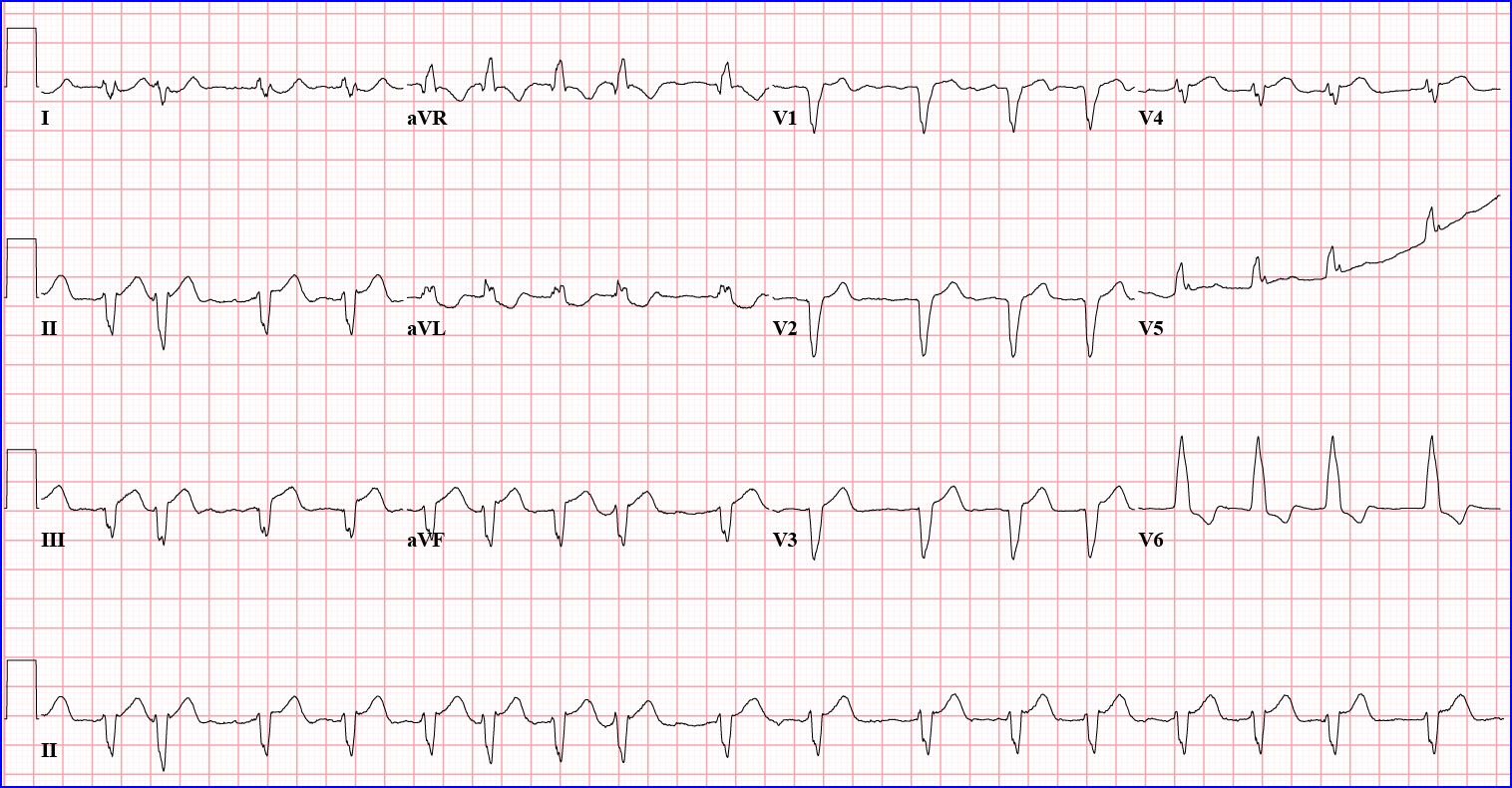
Does this EKG meet Sgarbossa criteria?

75 y/o male with history of a-fib presents with acute onset of substernal chest pressure 2 hours prior to arrival.   Does his EKG meet Sgarbossa criteria for the diagnosis of an acute MI in the presence of a LBBB?

Click on image to enlarge.

Scroll down for answer 


No.  While the ST segments do appear to be elevated in leads II, III and avF, to technically meet Scarbossa criteria, there must be ST segment elevation of 5 mm or more that is discordant with the QRS complex.  Of note, this ECG criteria has the weakest predictive value of all three Sgarbossa criteria.

The other Sgarbossa criteria - which have greater predictive values for detecting acute MI in the presence of LBBB - are: 
  1. ST segment elevation of 1 mm or more that is in the same direction as the QRS complex in any lead 
  2. ST segment depression of 1 mm or more in any lead from V1 to V3

Source 

Goldberger, A.  "Electrocardiographic diagnosis of myocardial infarction in the presence of bundle branch block or paced rhythm"  Up to Date.  May 2011.

Paucis Verbis: Acetaminophen toxicity

Did you know that the American Association of Poison Control Centers reports that 10% of poison center calls are related to acetaminophen ingestions? That's a lot. This Paucis Verbis card reviews the basics of acetaminophen toxicity. I included the Rumack Matthew nomogram to help you plot out the patient's risk for hepatotoxicity.

In the Emergency Department, we often screen for acetaminophen toxicity for patients who may have ingested substances as a suicide attempt. We check the serum acetaminophen level 4 hours post-ingestion. Occasionally, we are surprised by a toxic level because in the first 24 hours, because symptoms are can be mild and nonspecific (abdominal pain, nausea, lethargy).

I have a "Rule of 150":
  • The toxic ingestion dose of acetaminophen is 150 mg/kg.
  • The serum acetaminophen level when N-acetylcysteine treatment should be started is 150 mcg/mL (see Rumack Matthew nomogram)
  • The starting IV dose of N-acetylcysteine is 150 mg/kg over 15 minutes.   


You can download this PV card:  [MS Word] [PDF]

References
Larson AM. Acetaminophen hepatotoxicity. Clin Liver Dis. 2007 Aug;11(3):525-48, vi. .

Trick of the trade: Nebulized naloxone

Overdoses of long-acting opiates, such as oxycodone and methadone, are challenging to manage, especially if these patients are chronically on opiates.

On the one hand, you want to reverse some of the sedative effectives with naloxone so that they aren't near-apneic and hypoxic. You also want to be able to take a history from them. On the other hand, you don't want to abruptly withdraw them with naloxone such that they become violent and agitated. It is a fine balancing act.

Long-acting opiates present a separate challenging because naloxone wears off fairly quickly in 30-45 minutes. These patients may require repeat dosings and/or a naloxone IV drip.


Trick of the Trade:
Nebulized naloxone

The beauty of naloxone is that it can be administered through a variety of routes which includes IV, IM, and intranasal. Reported in 2003 in the Journal of EM, the nebulized route is also effective.

Advantages:
  • Nebulized naloxone does not require an IV, which is often difficult to establish in IV drug users.
  • Instead of administering multiple doses of naloxone for long-acting opiates, nebulized naloxone can provide a steady, low maintenance dose similar to an IV drip but without needing an IV.
  • Nebulized naloxone is a self-titrating medication because when the patient awakens, s/he often will pull off the mask.

A good starting regimen is 1-2 mg naloxone in a total volume of 3-5 mL. You may need to add normal saline to reach the target volume. I recently used 1 mg naloxone in 3 mL with great success. The patient was able to give a brief history and remained non-agitated. For longer-term naloxone treatment, you will need to refill the nebulizer canister intermittently or request a large-volume nebulizer canister.

Note: If you need to reverse opiates more quickly, you might consider giving an intranasal dose of naloxone first, followed by a maintenance dose using the nebulizer.

Thanks to Dr. Ethan Cowane (Jacobi Medical Center) for this tip!

Reference

Mycyk MB, Szyszko AL, Aks SE. Nebulized naloxone gently and effectively reverses methadone intoxication. J Emerg Med. 2003 Feb;24(2):185-7.
online dating chat rooms,free online dating chat,online dating chat tips,dating sites chat,chat avenue dating,online games dating,online chat singles,love dating online dating chat rooms,free online dating chat,online dating chat tips,dating sites chat,chat avenue dating,online games dating,online chat singles,love dating